
.svg)
.svg)
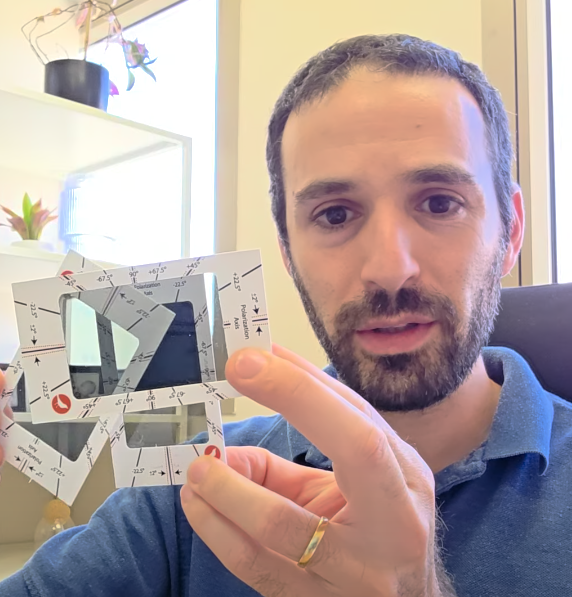

Imagine a sealed box with a small slit on each side. Light is supposed to pass through it, but in practice? Nothing. Complete darkness.
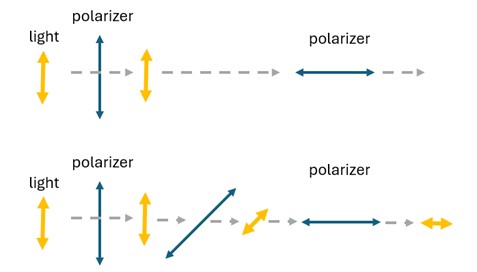
The reason? Inside the box are two polarizers placed at right angles, one at the entrance and one at the exit, so no light can get through (top image). But then something strange happens. I insert a third polarizer between the existing two. A polarizer, mind you, an element whose only function is to block light that’s not aligned with its polarization. And suddenly, light comes out the other side!
How is that possible? How can adding another blocking element allow light to pass?
To understand this, it helps to recall Malus’s Law. This law states that the intensity of light passing through a polarizer depends on the cosine squared of the angle between the light’s polarization and the axis of the polarizer. In other words, the smaller the angle, the more light gets through; the larger the angle, the less light passes. When two polarizers are perpendicular (90° apart), no light passes. But if we insert a third polarizer between them, angled at 45° relative to each, the middle polarizer gradually shifts the polarization, in two steps, with partial loss at each stage. As a result, some light manages to make it through! (See bottom image.)
We can draw an analogy between this experiment and the general principle of impedance matching, used for example in the world of ultrasound. During an ultrasound scan, a special gel is applied to improve the transmission of sound waves from the transducer into the body. Without the gel, most of the sound waves would reflect due to the large impedance mismatch between air and skin. The gel mediates the transition by gradually matching the properties of the two materials, just like the middle polarizer in our experiment enables a gradual transition between the two polarization states.
And that’s a wrap on polarization! Check out our articles about SLMs - smart devices that control the phase of light to generate complex spatial patterns. As we’ll discover, polarization plays an important role here as well.






.png)
.png)


.jpeg)