
.svg)
.svg)
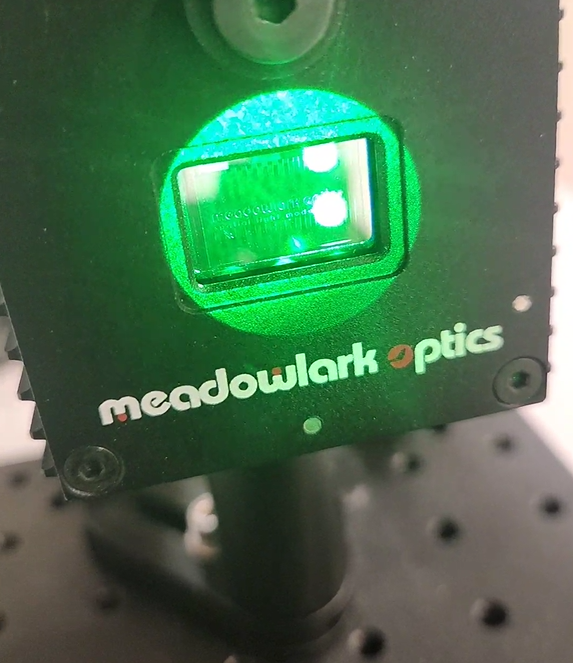

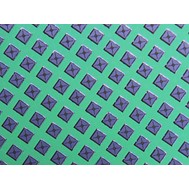
How does an SLM actually work? Behind the magic lies a simple and elegant mechanism. In each pixel, you’ll find transparent electrodes with liquid crystal molecules, or LC for short, sandwiched between them, characterized by their elongated shape. When linearly polarized light aligned with their long axis passes through, it accumulates phase according to their orientation, in other words, according to how well they are aligned.
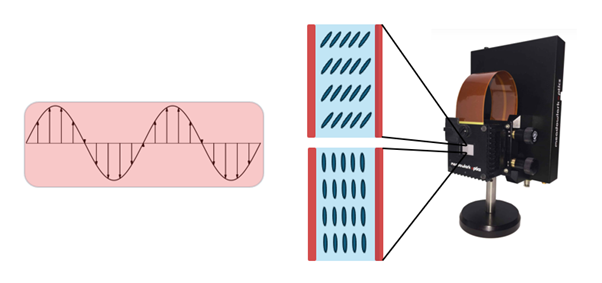
But how do we control that orientation? Simple, we apply a voltage across the cell. The voltage causes the molecules to rotate and align with the electric field, thereby changing the phase accumulated by the light passing through the pixel. By independently controlling the voltage at each pixel, we can design a custom phase mask with high precision.
However, this mechanism comes with challenges. The time it takes for the LC molecules to rotate and stabilize limits the response time of most SLMs to about 0.1 seconds, relatively slow. The good news is that there are specialized SLMs, such as those from Meadowlark, that use higher voltages and sophisticated driving schemes to reduce the response time down to a single millisecond.
Did you know? A standard SLM connects to a computer just like a regular display, using a simple DVI connection. Despite the convenience, this interface can also limit the refresh rate of phase masks and create dependence on the operating system, a dependence that may affect the performance of the entire system.
In the next article, we’ll dive into the million-dollar question, what matters more, phase or amplitude?




.png)
.png)



.jpeg)